
Robert MacBryde and Robert Colquhoun: Artists, Lovers, Outsiders, Kilmarnock review: 'dazzling'
This show is a valuable reminder of the achievements of two remarkable Scottish artists, writes Susan Mansfield


Robert MacBryde and Robert Colquhoun: Artists, Lovers, Outsiders, Dick Institute, Kilmarnock ★★★★
The Two Roberts, Colquhoun and MacBryde, were briefly the toast of the British art scene. In 1946, they were photographed for Vogue for a feature on Tomorrow’s Names. In 1948, when Alfred Barr, director of collections at the Museum of Modern Art in New York, came to London seeking the best young British artists, he bought five works: by Francis Bacon, Edward Burra, Lucien Freud and one by each of the Roberts.
A photograph taken by Felix Man for Picture Post in 1949 captures them in their Notting Hill studio, one on either side of an easel, posing with the studied nonchalance of two good-looking young men about to take on the world.
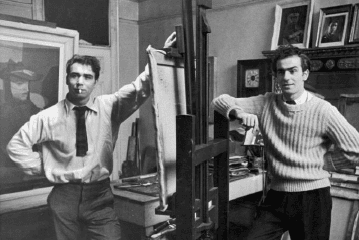
But their star faded as quickly as it rose. A decade later, they were broke and all but homeless, dependent on the generosity of friends. All too soon, according to writer and broadcaster Damian Barr whose novel The Two Roberts was published last year and who curated this exhibition for contemporary art space Charleston, near Lewes, they slipped into the footnotes of art history.
The Charleston exhibition was the first major show of their work in England since 1962, now at the Dick Institute in Kilmarnock, near where both grew up. Here in Scotland, their legacy has had some more attention - including a major retrospective by National Galleries Scotland in 2014 - but with few works on public display anywhere, they are still in danger of falling through the cracks. This show is a valuable reminder of who they were and what they did.

Colquhoun and MacBryde met at Glasgow School of Art in 1933. Both working-class lads from Ayrshire - Colquhoun from Kilmarnock, MacBryde from Maybole - they seem to have forged an alliance immediately, and remained partners, personally and professionally, until Colquhoun’s death in 1962. The double portrait by their GSA tutor, Ian Fleming, for which he won the Guthrie Prize in 1937, captures them at the moment of leaving art school, Colquhoun pensive and slouched, MacBryde, relaxed and boyish.
The following year, thanks to a travel scholarship, they made their way across Europe even as it fell under the shadow of fascism, drinking in the possibilities offered by European art. They absorbed European modernism so thoroughly, they were later nickname MacBraque and McPicasso. In the early 1940s, they settled in London, in a studio in Bedford Gardens, Notting Hill, where they also lived and - by all accounts - hosted splendid parties. Colquhoun had his first solo exhibition in 1943 at the LeFevre Gallery. He was 29.

Colquhoun’s work is the more immediately striking. A group of paintings made in the late 1940s and early 1950s show how he absorbed the influence of Picasso and cubism, vividly making them his own. Pictures such as The Goatherd, Woman with Goat and Girl and Pig feel European both in subject matter and style. The draughtsmanship and composition are superbly confident and - though MacBryde tends to be regarded as the superior colourist - there’s a fine facility with colour as well. This show introduces several previously unseen paintings, including Colquhoun’s Man Holding Stick (1946), which was recovered from a rubbish tip in New England in 2025.
In The Spectators (1949), Colquhoun gives his two figures the features of himself and MacBryde, one of several in which he does this. Barr suggests that, at a time when homosexuality was still taboo and illegal, this might be the only way he could publicly acknowledge their relationship in his work. 1958’s Women in Ireland takes this figurative work to another level, powerful and timeless, full of dignity and sadness.
It’s no surprise that the show is heavy on biographical detail. Barr has spent years with the Roberts, and can’t resist sharing anecdotes and details: postcards they brought back from Europe, newspaper cuttings collected by Colquhoun’s mother, drawings they used as “beer tokens” when they were broke. Quite a bit of space is given to the designs they created collaboratively for Léonide Massine’s Scottish themed ballet, Donald of the Burthens, which was staged at the Royal Opera House in 1951.
Then there are works by those who were important to them: John Minton, who shared their home and studio, and possibly more, for several years; Polish emigré Jankel Adler, who encouraged them to look to Europe for inspiration. Wilhelmina Barns-Graham even pops up because Colquhoun taught her “offset drawing”, having learned it from Adler, who learned it from Paul Klee.
All this is interesting, but it feels like a bit of a distraction from the main event: the paintings by the Roberts. Colquhoun grabs the attention, as perhaps he always did, but the MacBrydes are, in their own way, equally extraordinary. In the household, we’re told, MacBryde took care of the domestic chores, as well as handling the business end of the partnership. Critics often positioned him as second fiddle to Colquhoun, which Colquhoun himself refuted.

Most of MacBryde’s paintings here are still lifes, with works like Fruit on a Caucasian Cloth and Still Life with Mandolin demonstrating an assured handling of form and colour which lands with complete authority. While some contemporaries seem to have doubted that MacBryde could paint figures, Man with a Melon (1952) is a compassionate, direct painting of figure and mood which is dappled with the striking colours of light shining through stained glass.
There are many reasons why promising careers are cut short. Barr contends that being gay, working-class and Scottish led to the Roberts being sidelined, that they were “trailblazers” who “paid a heavy price”. While it’s difficult to quantify how these factors might have affected their reputations, it’s likely that they did make the pair more vulnerable when the sales dried up, the solace of the bottle beckoned, and the fickle art world put its attention elsewhere, notably America and pop art.
Colquhoun died of a heart attack aged 47 while working night and day for a show MacBryde had secured which he hoped would be a comeback (it appears that he was working on a monoprint inspired by Michael Wolgemut’s Dance of Death when he died). MacBryde struggled to make art after his partner’s death and died four years later, hit by a car outside a Dublin pub.
Barr’s novel has reclaimed their story for a 21st-century audience which is eagerly embracing queer histories. The exhibition sits alongside it a little awkwardly, retelling elements of that story. The first job of an exhibition, however, is to show the work, to ask how it stands up after 70 years. The good news is that it does, without question. And the best of it is dazzling.
Until 10 January
The Scotsman’s arts newsletter is now sent twice a week - subscribe today
Enjoying the Arts & Culture journalism on scotsman.com? Make it easier to find by selecting us as a preferred Google source
Want the latest Scottish headlines sent directly to your phone? Sign up to our new WhatsApp channel here
Comments
Want to join the conversation? Please or to comment on this article.